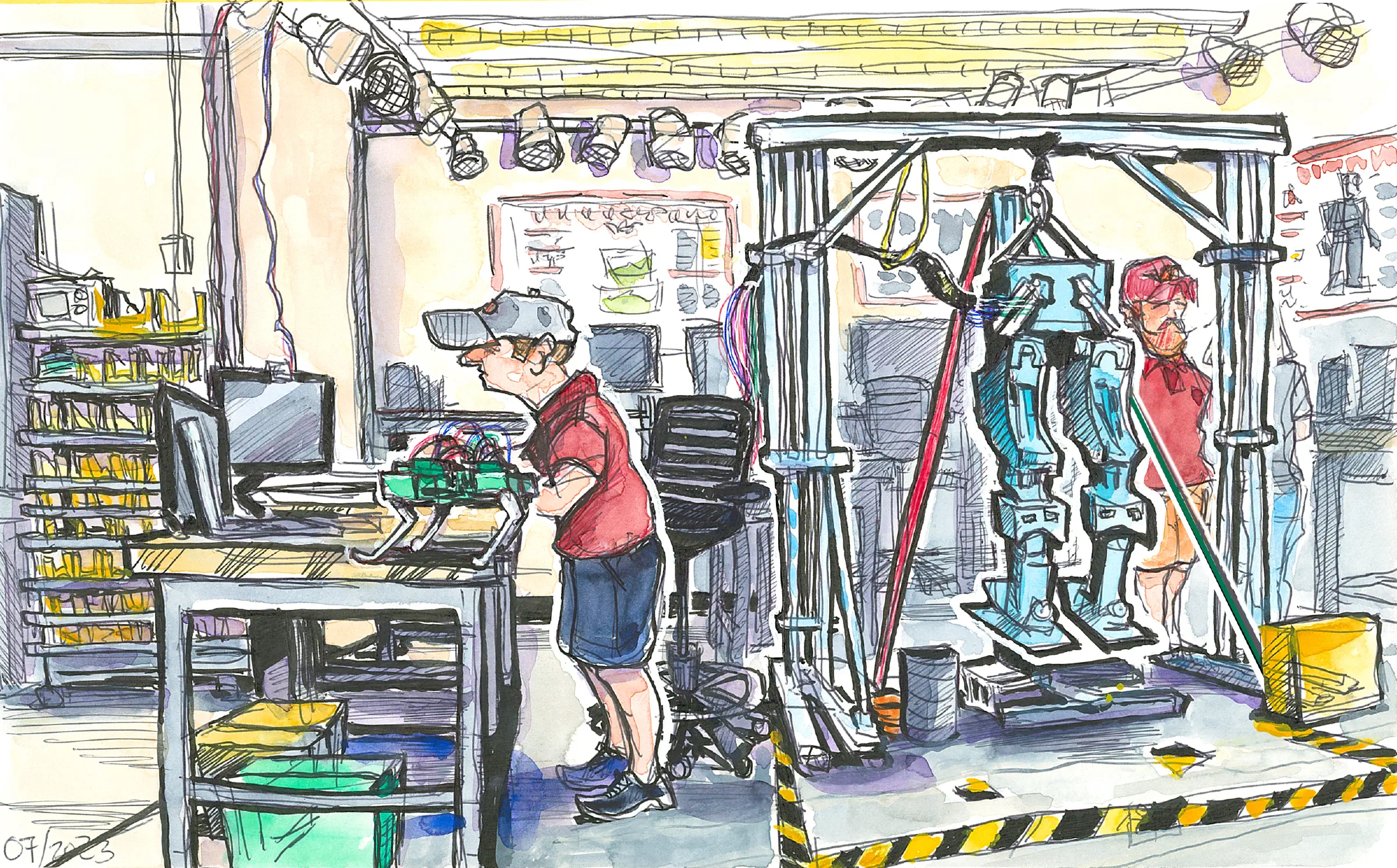
Doodle by Steven White
Virginia Robotics Symposium
October 23, 2026 · 9:30 AM – 5:00 PM
Virginia Tech Graduate Life Center (GLC) · Blacksburg, VA
Thank you for attending VRS 2026!
Doodle by Steven White
October 23, 2026 · 9:30 AM – 5:00 PM
Virginia Tech Graduate Life Center (GLC) · Blacksburg, VA
Thank you for attending VRS 2026!
VRS 2026 took place on October 23, 2026 at the Virginia Tech Graduate Life Center in Blacksburg. Thank you to all speakers, poster presenters, and attendees!
The Virginia Robotics Symposium (VRS) brings together robotics researchers from across the Commonwealth for a one-day event of research talks, poster presentations, and social activities — building connections and disseminating ideas across institutions.
Thank you for attending VRS 2026! Registration has closed.
Students are encouraged to present research posters. Poster sign-ups have closed.



VRS is a one-day event with keynote talks, a panel, poster presentations, and social activities.
Anticipatory Planning: Integrating Learning and Planning to Enable More Forward-Thinking Long-Lived Mobile Robots
The next generation of household robots will be long-lived, operating over deployments lasting hours or days. However, most mobile robots are problematically myopic: existing robot task planning strategies typically focus only on completing an immediate objective as quickly as possible, yet since the environment persists, such strategies often render the environment more difficult to use as time goes on and introduce side effects that impede later tasks. Instead, if robots are to enter homes or hospitals and act as assistive companions over lengthy deployments, they must strive to maximize their long-lived utility and so must have the capacity to interleave quick, reliable, and unobtrusive completion of their assigned objectives with proactive action, preparation for future tasks, and maintenance of the long-term usability of the environment, an aim for which myopic planning is insufficient.
In this talk, I will discuss my lab's recent progress towards what we call anticipatory planning, in which estimates of expected future cost—the expected impact of the robot's actions on the uncertain future—to inform planning to guide the robot towards proactive and forward-looking behaviors that jointly prioritize long-term usability of the environment with execution of its assigned objectives. I will showcase both completed and ongoing work that shows the potential of this approach to enable more capable and effective long-lived mobile robots and speculate on the broad future of this line of research.
Embedding biological intelligence into soft robots
Robotics cannot yet match the dexterity and agility of animals. This is particularly true in the realm of soft robotics. While biological inspiration comes from the incredible potential of octopus arms and elephant trunks, current soft robot implementations struggle to perform basic useful tasks. This talk will explore how incorporating lessons from biology can help us improve the design and control and soft robots in situations where traditional approaches struggle. With examples from octopus arm, snake bellies, and spider webs, I will show how biological creatures have developed mechanically intelligent body forms, actuation strategies, and sensing modalities that enable their exceptional functionality and describe how our lab is working to translate these principles into new generations of soft robots.
Flexible Wearable Electronics and Robotics: Towards Ubiquitous Monitoring and Assistance
Wearable technologies offer the potential to bring continuous health monitoring and personalized physical assistance into everyday life. Realizing this potential requires systems that integrate comfortably with the human body, reliably interpret physiological and movement signals, and respond to users’ needs. The recent progress in smart fabrics, textiles, and garments and their manufacturing techniques has opened the door for next-generation wearable electronics with fully flexible systems on cloth. The controllable structures and the potential of automatic design-to-manufacturing translation of textile materials also inspire researchers to explore new textile actuators and create softer and more compliant wearable robotics. The first part of the talk will introduce textile electronics that transform everyday fabrics into functional platforms for sensing and human-robot interaction. A central focus is a programmable design-to-fabrication approach that translates electronic functions into machine-executable embroidery patterns, enabling the integration of conductive interconnects, electronic components, and sensors within textile structures. The second part will introduce a new class of wearable robots and soft exosuits for movement assistance, with an emphasis on understanding human motion intention and coordinating robotic support. EEG-based brain-computer interfaces will illustrate how neural signals can connect intended movement with wearable assistance.
Toward Adaptive Collaboration in Human-Robot Teams
As robots increasingly operate alongside people in complex and dynamic environments, effective collaboration requires them to coordinate not only with other robots, but also with multiple human teammates whose goals, roles, and behaviors may evolve over time. In this talk, I will present our research on developing reliable and adaptive collaborative robotic systems for multi-human-robot teams. I will discuss approaches that combine decentralized coordination, symbolic reasoning, plan verification, and adaptive execution to support collaborative task completion in dynamic environments. Through simulation and physical robot experiments, I will illustrate how robots can coordinate interdependent actions, monitor task progress, and respond to unexpected interruptions through targeted recovery and replanning. I will conclude by discussing how these capabilities can be extended to teams in which robots must also reason about human intent, interaction, and trust to support effective collaboration.
Optimal Control is Not Good Enough for Robot Swarms
What if the biggest obstacle to scalable robot swarms is our obsession with optimization and control?
Control theory and computer science have spent decades learning how to make engineered systems increasingly precise, optimal, and predictable. But a swarm is not simply a multi-robot system with a very large N. As the number of agents N grows, global state becomes inaccessible, communication becomes intermittent, models become wrong, failures become normal, and the cost of coordinating everyone with everyone becomes overwhelming. In highly dynamic and/or adversarial environments, continuing to search for the best action can lead to decision paralysis when almost any reasonable action would be better than none at all.
Biology suggests a radically different mode of "control" for swarms. A beekeeper does not compute trajectories for thousands of bees, assign tasks to individual workers, or continuously optimize the state of the colony. Instead, the environment is shaped so that local behaviors, interactions, and feedback naturally produce useful collective outcomes. The individual agents largely control themselves. What is “controlled” are the conditions under which self-organization occurs.
This talk argues that optimal control is not the same as good enough. Rather than asking how to command, coordinate, or optimize every agent, we should ask: What local rules reliably produce useful global behaviors? What environmental variables, interaction structures, or boundary conditions can we manipulate to steer an entire population? Which collective variables actually need to be regulated and how little information and intervention are required to keep the swarm inside a region of acceptable behavior?
Drawing on distributed control, computer science, event-triggered systems, collective behavior, and cybernetics, I will explore a shift from controlling agents to controlling the environmental conditions for emergence. The challenge for swarm robotics is therefore not to extend multi-robot optimization to increasing N. It is to develop a different theory of control for systems of systems of systems (of systems...) in which useful behavior is self-organized rather than commanded. To control a million robots, we may first have to stop trying to control a million robots.
| Time | Event | Location |
|---|---|---|
| 9:30 AM | Sign In and Morning Coffee | GLC |
| 10:00 AM | Welcoming Remarks | GLC |
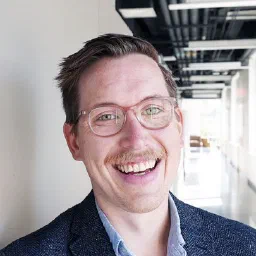
| 10:10 AM | Noel Naughton Embedding biological intelligence into soft robots | GLC |
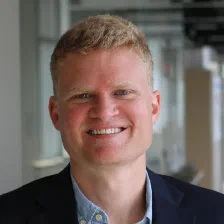
| 10:35 AM | Ye (Sarah) Sun Flexible Wearable Electronics and Robotics: Towards Ubiquitous Monitoring and Assistance | GLC |
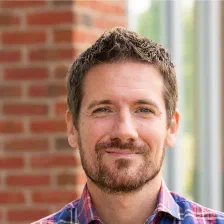
| 11:00 AM | Tariq Iqbal Toward Adaptive Collaboration in Human-Robot Teams | GLC |
| 11:25 AM | Lunch (Boxes Provided) | GLC |
| 1:00 PM | Poster Session | GLC |
| 3:00 PM | Afternoon Coffee | GLC |
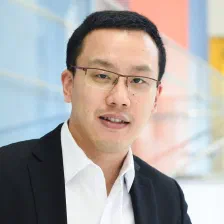
| 3:20 PM | Cameron Nowzari Optimal Control is Not Good Enough for Robot Swarms | GLC |
| 3:45 PM | Gregory Stein Anticipatory Planning: Integrating Learning and Planning to Enable More Forward-Thinking Long-Lived Mobile Robots | GLC |
| 4:10 PM | Panel Debate | GLC |
| 4:45 PM | Awards and Closing Remarks | GLC |
| 5:00 PM | End of Event | GLC |
The 2026 symposium will be hosted at the Virginia Tech Graduate Life Center (GLC) Multipurpose Room at 155 Otey St NW, Blacksburg, VA 24061.
Parking is not provided by the symposium and participants are responsible for their own parking. We recommend ParkMobile for parking. Additionally, the Kent Square and North End parking garages, shown below, are both a short walk from the GLC.
Venue
Virginia Tech Graduate Life Center (GLC)
Open in Google MapsParking
Kent Square Parking Garage
Open in Google MapsParking
North End Parking Garage
Open in Google MapsFor more information, please reach out to the organizers below.